Empowering and Transforming Medical Affairs to Accelerate Impact

Choosing Your North Star: Selecting an AI Consulting Partner for Medical Affairs
Move beyond the generic “AI Experts”
As Medical Affairs shifts from a reactive support function to a predictive, insight-driven strategic partner, the pressure to integrate Artificial Intelligence is immense. However, the market is saturated with “AI experts” who lack the nuance required for pharmaceutical medical strategy. In 2026, selecting the right consulting firm isn’t just about technical prowess; it is about finding a partner that understands the delicate balance between innovation, scientific integrity, and regulatory rigor.
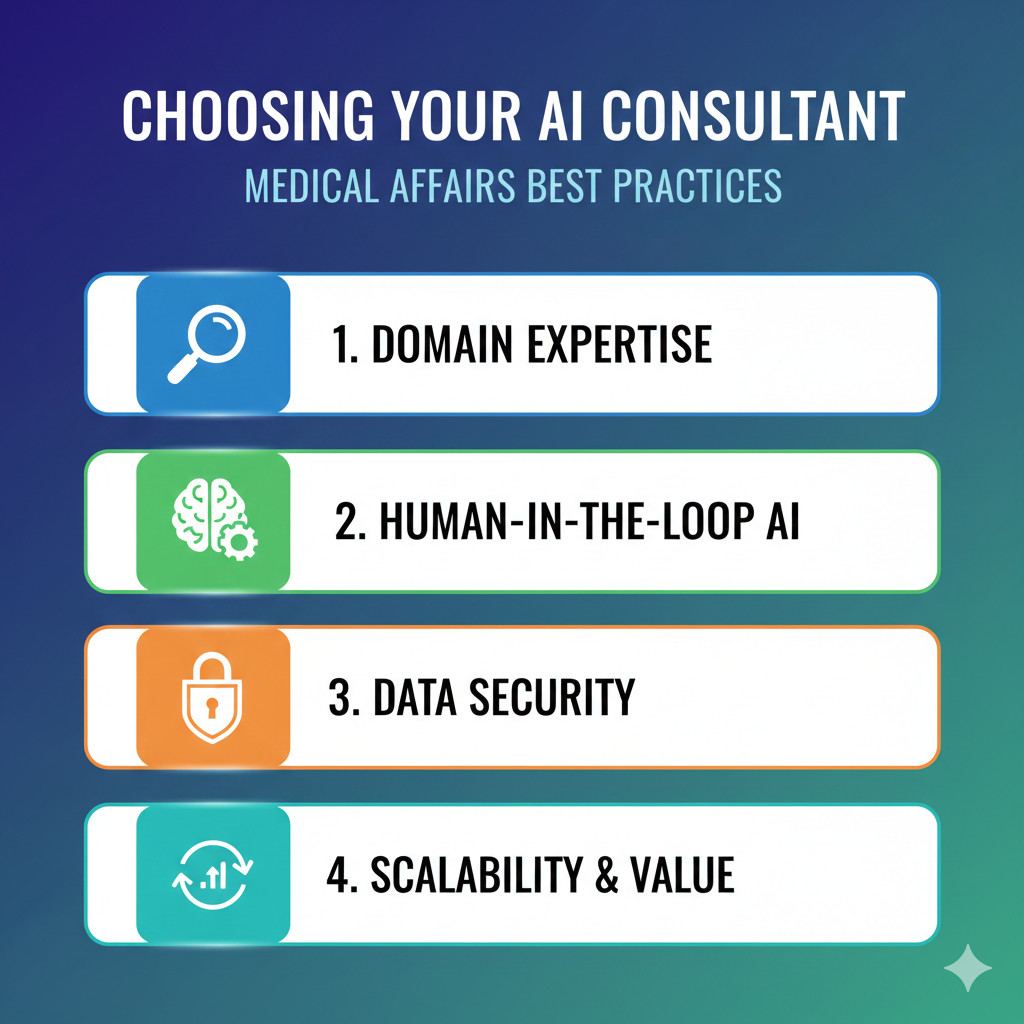
When evaluating a firm for your department, prioritize these four pillars:
1. Domain Specific “Deep” Context
Generic AI firms often struggle with the “Medical” in Medical Affairs. A partner must demonstrate a profound understanding of MSL workflows, the nuances of scientific exchange, and the intricacies of Medical Information inquiries.
- Quick Litmus Test: Can they articulate the difference between a commercial lead and a medical insight? Do they understand how to handle unstructured field notes without losing the underlying scientific sentiment?
2. Clinical Validity and “Human-in-the-Loop”
In healthcare, a “hallucination” isn’t just a glitch it’s a risk to patient safety and compliance. Look for partners who prioritize explainability over “black box” solutions.
- Key Consideration: The firm should have a methodology for clinical validation. They must build systems that augment, rather than replace, human expertise, ensuring that every insight is reviewable and traceable back to a validated medical source.
3. Rigorous Data Governance and Security
Medical Affairs handles sensitive Real World Evidence and proprietary pipeline data. Your consulting partner must have a clear strategy for data residency and segregation.
- Essential Inquiry: Ask how they protect your data from escaping into the training sets of general Large Language Models.
4. Scalability Beyond the “Pilot Trap”
Many firms can build a flashy demo, but few can scale a solution across a global MA organization.
- Strategic Alignment: Choose a partner that focuses on how they will help you identify high impact, small win pilots, such as automating literature monitoring or MSL pre-visit planning, while providing a roadmap for long-term digital maturity and future proofing.
In conclusion, the right AI consultant should act as an extension of your team, helping you modernize without compromising the “Medical” soul of your mission. Start with the right strategic questions, not just the right tools.
References:
- G & Co. “Top Healthcare AI Consulting Firms to Work With – February 2026.”
- Envision Pharma Group. “Strategic AI use cases and lessons learned in medical affairs: Perspectives from Amgen and Novo Nordisk.” (January 2026).
- Strategy& (PwC). “Unlocking the power of AI in Medical Affairs.” (March 2025).
- Rethinking The Future (RTF). “How to Choose the Right AI Consulting Company in 2026?” (February 2026).

You have the mandate to innovate, but is your medical affairs artificial intelligence strategy truly transforming your team, or just adding to the noise and fear? Find out more.
Medical Affairs Artificial Intelligence Pillars
- Medical Affairs Automation Road Maps
- Omnichannel Strategy Integration
- Custom AI Tools
- Innovative AI Medical Affairs Training

Unlock Your Competitive Edge
Details on what Triple Helix can do for your team
- Showcase MSL Impact
- MSL Strategy Optimization
- Inaugural Field Medical Affairs (MSL) Teams
- MSL Team Expansion and Contraction
- New Product Launch Planning
- Industry Fellowship Blueprints

Best Practices: Are you running your 2026 Medical Affairs team on 2019 habits?
Move “soon” up to “now”
Let’s be honest. Plugging advanced AI into messy outdated processes doesn’t make for efficiency. It usually just helps you create chaos at record speed. Go beyond the pilot and automate your workflows now.